
Mowing a lawn sounds simple until the lawn decides to fight back. Steep banks, tall grass, rocks, and uneven ground can turn routine lawn care into hard work. That is where we see the real value of a remote-controlled lawn mower. Instead of sitting on the machine, we can stand at a safer distance and guide it with a remote.
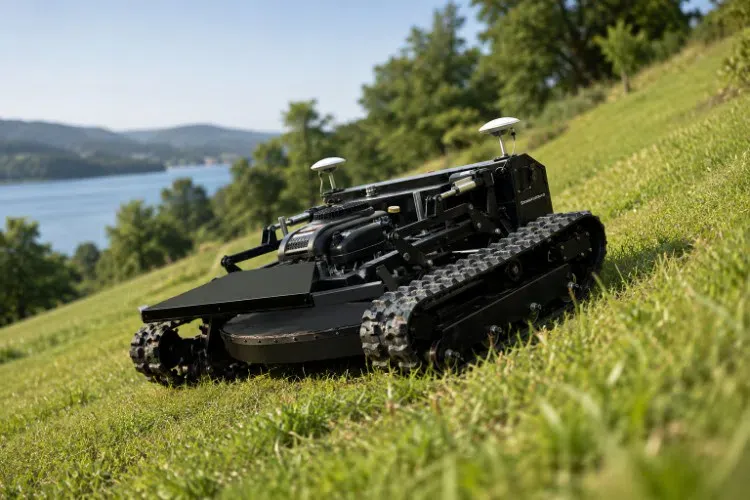
Modern remote control mowers offer more than convenience. They combine strong traction, flexible control, and practical cutting systems for difficult jobs. Research also shows that specialized remote-controlled mowers can improve mowing efficiency on steep slopes and tall vegetation.
1. Safer Mowing on Steep Slopes
Keep the Operator Away From the Hazard
Safety remains one of the biggest benefits of remote control technology. With a traditional mower, the operator stays close to the machine. On a steep slope, that position can become dangerous very quickly. A remote control slope mower lets us control the machine from a safer location.
This design helps us work around steep banks, roadside areas, drainage channels, and other risky locations. OSHA warns operators to respect manufacturer slope limits and avoid rollover hazards.
Better Control on Difficult Ground
A purpose-built slope mower often uses tracks or specialized wheels. These systems can improve traction on uneven terrain and loose surfaces. A low center of gravity also helps the machine stay stable during operation.
Of course, no mower can ignore physics. We must always follow the manufacturer's slope limits and safety instructions. Wet grass can also reduce traction, so weather matters.
2. Excellent Performance on Challenging Terrain
Reach Areas Other Mowers Cannot
Some mowing areas simply do not welcome a ride-on mower. Think about steep hillsides, narrow paths, orchards, riverbanks, and spaces beneath solar panels. A compact remote-controlled machine can reach areas that larger equipment may struggle to access.
This flexibility makes remote machines useful for commercial landscaping and property maintenance. We can move the mower into a difficult zone without putting the operator inside it.
Handle Tall Grass and Heavy Growth
Tall grass can quickly become a headache. Standard lawn equipment may struggle when vegetation grows beyond normal lawn height. Specialized remote-controlled machines can use strong cutting systems for heavier vegetation.
A recent Japanese research project developed a remote-controlled mower for weeds over 1 meter tall. The prototype achieved twice the work efficiency of a commercial remote-controlled mower.
3. More Efficient Lawn and Vegetation Management
Cover Large Working Areas
Efficiency matters when we maintain large properties. A suitable remote machine can cover large areas without requiring the operator to walk behind it. This can reduce physical effort during long mowing sessions.
We can also plan our mowing route more freely. Instead of constantly repositioning ourselves beside the machine, we guide it from a practical viewing point. That small change can make a long workday feel much shorter.
Reduce Physical Strain
Traditional mowing can involve pushing, walking, lifting, and repeated turning. That effort adds up after several hours. Remote control operation lets us focus on steering rather than physically moving the mower.
For professional crews, this can make daily work more comfortable. For property owners, it can make demanding mowing jobs less exhausting. In short, the machine does the heavy work while we keep our energy.
4. Flexible Cutting and Better Results
Adjust the Cutting Height
Different grass conditions need different settings. A flexible cutting height helps us match the machine to the job. Short lawn grass may need a lower setting, while tall vegetation often requires more clearance.
The right setting also helps protect the turf. We can gradually reduce grass height instead of forcing the machine through dense growth in one pass.
A Strong Cutting Edge Matters
The cutting edge determines how effectively the mower handles vegetation. A powerful cutting system can deal with grass, weeds, and heavier growth more efficiently.
We should still avoid treating every machine like a superhero. Blade condition, vegetation density, speed, and terrain all affect performance. Regular inspection helps keep the cutting system working properly.
5. Better Access Than Traditional Mowers
Work Around Obstacles
Challenging terrain often includes more than slopes. Trees, fences, rocks, posts, buildings, and narrow spaces can create awkward mowing conditions. A compact remote-controlled machine can maneuver around many of these obstacles.
This makes it useful for orchards, farms, parks, roadside green areas, and industrial properties. We can choose our working position without carrying a heavy machine through every obstacle.
Work on Uneven Ground With Less Compression
A conventional mower can place considerable weight on the grass. That becomes a problem when the ground remains soft or uneven. Remote-controlled machines often operate without a rider's weight, which can reduce ground pressure.
Kawasaki notes that remote-controlled mowers can work on uneven ground while avoiding the additional weight of a seated operator.
6. Remote Control vs. Robot Mowers
Remote Control Gives Immediate Direction
Robot lawn mowers and a robot mower can offer excellent convenience. However, autonomous machines usually depend on mapping, boundary systems, sensors, or positioning technology. A remote-controlled mower works differently.
We decide where the machine goes and when it cuts. That direct control becomes valuable when the terrain changes frequently, or the work area has unusual obstacles.
Choose the Right Machine for the Job
Remote control does not automatically mean better in every situation. A robotic mower can be excellent for regular residential lawns. A remote-controlled machine can make more sense for slopes, tall grass, and difficult terrain.
The key question is simple: What does your property actually demand?
7. A Smarter Choice for Professional Lawn Care
Lower Risk, Higher Flexibility
For professional lawn care, flexibility can create a major advantage. One machine may handle slopes, rough grass, uneven areas, and hard-to-reach spaces. That versatility can reduce the need to switch between several types of equipment.
Remote machines can also support work near roads, water, and other hazardous areas. Industry guidance recommends site risk assessments and strict operating distances when using remote mowers on slopes.
What Should You Look For?
Before choosing a remote-controlled mower, we recommend checking these points:
Maximum approved slope angle
Track or wheel drive system
Cutting width and cutting height
Blade or cutting-head design
Remote operating range
Emergency stop function
Ground clearance
Battery or engine capacity
Maintenance requirements
Performance on wet or uneven terrain
A good machine should match the terrain rather than simply look powerful on paper.
Why Remote-Controlled Mowing Makes Sense
The biggest advantage is not one feature. It is the combination of safety, control, access, and productivity. A remote-controlled lawn mower can help us manage slopes, tall grass, uneven ground, and difficult work areas with less physical strain.
Traditional mowers still have their place. A ride-on mower can quickly handle open lawns, while robot lawn mowers can automate routine residential mowing. However, remote control mowers fill an important gap between conventional equipment and fully autonomous machines.
For us, that is the real appeal. When the terrain gets tough, the mower should take the challenge—not the operator. With the right drive system, cutting setup, and safety practices, remote-controlled mowing can make difficult lawn care feel surprisingly manageable.
References
OSHA — Riding Mower Safety and Slope Hazards.
J-STAGE — Development of Remote-Controlled High-Efficiency Mower for Steep Slopes.
British Association of Landscape Industries — Remote and Robotic Mower Slope Safety Guide.
Kawasaki Engines — Guide to Selecting a Remote Control Lawn Mower.
Gravely — Steep Slope Mowing With Remote-Controlled Mowers.


