
Choosing the right mower depends on more than grass and engine power. Terrain, working time, safety, and cutting conditions all matter. At Shandong RAYWAY Lawnmower, we see these factors every day. That is why we often compare a remote control lawn mower with traditional equipment.
A remote mower vs lawn mower comparison can reveal major differences. A push mower may work perfectly on a small, flat lawn. However, difficult terrain can change the whole situation. Steep inclines, tall grass, and uneven ground demand different equipment.
So, which machine fits your work? The answer depends on where you mow and what you expect from the machine.
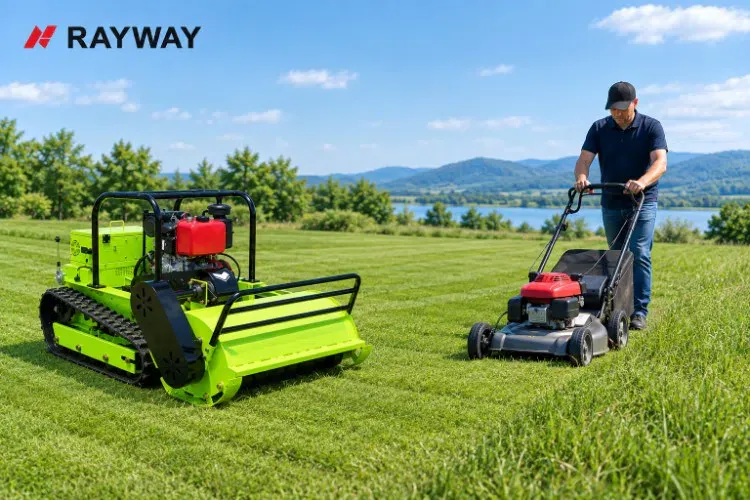
Remote-Controlled Lawn Mower vs Traditional Lawn Mower
The biggest difference comes from how the operator controls the machine. A traditional mower usually requires the operator to walk behind it or ride on it. A remote mower lets the operator control the machine from a safe position.
This difference becomes important on slopes. OSHA advises operators to follow manufacturer slope limits and assess rollover hazards before mowing. It also warns about wet surfaces, slopes, drop-offs, and uneven ground.
How the Two Mower Types Work
Traditional mowers use familiar controls. A push mower needs physical effort from the operator. Ride-on machines reduce walking but still place the operator on the machine.
A remote mower uses a handheld controller. The operator can control travel, steering, mowing, and often height adjustment from a distance. Some professional models also provide safety controls and emergency-stop functions.
The operator can therefore stay away from blades, dust, heat, and unstable slopes. Several professional manufacturers design remote mowers specifically for steep and hazardous terrain.
Where Traditional Mowers Still Make Sense
Traditional mowers remain useful for many normal lawns. They offer simple operation and easy access to basic maintenance. A small lawn does not always need advanced remote technology.
For example, a homeowner may only need a compact push mower for a flat garden. In that case, a traditional machine can provide a straightforward solution. There is no reason to bring a mountain goat to mow a football field.
The key is matching the machine to the job.
Manual Mower Comparison: Terrain and Grass Conditions
Terrain creates one of the clearest differences between mower types. Flat grass presents few challenges. Difficult terrain can quickly expose the limits of ordinary machines.
A manual mower comparison should therefore consider slope, traction, grass height, soil condition, and obstacles. These factors affect both cutting quality and operator safety.
Steep Slopes and Uneven Ground
Handling steep slopes requires careful equipment selection. Traditional riding mowers often have strict slope limits. OSHA recommends following the manufacturer's instructions and avoiding slopes beyond approved limits.
Remote-controlled tracked machines can provide stronger traction on challenging surfaces. Some professional models use rubber tracks, low centers of gravity, and heavy-duty drive systems. For example, AS-Motor lists remote-controlled models designed for slopes and dense vegetation.
However, slope ratings vary by machine. We should never treat one model's rating as universal.
Tall Grass and Rough Vegetation
Tall grass creates another major difference. Standard residential machines often work best when operators mow regularly. Long grass can increase the load on the cutting system.
Professional remote mowers often use stronger decks and engines. Some models also use flail cutting systems for dense vegetation. This makes them useful for orchards, embankments, solar farms, and other rough areas.
The correct cutting system still matters. Grass height, vegetation density, and moisture can affect performance.
Cutting Performance and Machine Specifications
Mowing performance depends on several technical parameters. We should look beyond engine size when comparing equipment.
Important specifications include:
Cutting width: wider decks cover more ground per pass.
Cutting heights: different grass conditions need different settings.
Drive system: tracks or wheels affect traction.
Engine power: power helps when cutting dense vegetation.
Working speed: speed affects total productivity.
Control range: remote work requires reliable communication.
Machine weight: weight affects traction and ground pressure.
Cutting Width and Cutting Heights
Cutting width directly affects mowing efficiency. A wider deck can reduce the number of passes across large areas. However, a narrow deck can work better around trees, fences, and tight spaces.
Cutting heights also matter. Short grass may need a lower setting. Tall or stressed grass often benefits from a higher first cut.
Many professional remote mowers allow the operator to control deck height. Some machines can adjust the deck directly from the remote controller.
This gives operators more control in changing field conditions.
Power, Drive Systems, and Traction
Traditional gas powered mowers remain common because fuel provides strong and familiar power. They can handle many demanding mowing tasks.
However, power alone does not solve traction problems. A powerful mower can still struggle on wet or uneven ground. The drive system must match the terrain.
Tracked remote mowers can spread machine weight over a larger contact area. This can help improve stability and traction on difficult surfaces. Some professional machines specifically combine tracks with low centers of gravity.
Remote Mowers vs Robot Lawn Mowers
People sometimes confuse remote-controlled mowers with robot lawn mowers. They are related, but they serve different purposes.
Robotic mowers focus on autonomous lawn maintenance. They can operate automatically and return to a charging station. Many residential systems use boundary wires or virtual boundaries to define the working area.
A remote mower usually gives the operator direct control in real time. This makes it more suitable for active mowing in rough terrain.
Autonomous Robotic Mowers
Modern robotic mowers can handle routine lawn maintenance with limited human input. Some models automatically return to the charging station when they need power.
They work well for regular lawns with predictable layouts. Many models also support app control and automatic scheduling.
However, buyers must check slope specifications carefully. Husqvarna documentation shows that slope limits can differ between the working area and the boundary. Wet conditions can also reduce traction.
Boundary Wires and Real-Time Control
Boundary wires can define the operating area for some robotic systems. They provide a clear virtual fence around the lawn.
However, installation can become more complex on slopes. Some systems have lower boundary-slope limits than their internal working-area limits. Manufacturers provide specific installation requirements for each model.
A remote mower takes another approach. The operator watches the machine in real time and guides it around obstacles. This direct control can help when terrain changes quickly.
Wet Grass, Safety, and Environmental Factors
Weather can change mowing conditions dramatically. Wet grass can reduce traction and increase the risk of slipping. It can also make mowing less predictable on slopes.
Robotic mower documentation specifically notes that wet grass can increase wheel-slip risks on slopes.
Safety on Difficult Terrain
Safety should come before cutting speed. We recommend checking the slope, surface, obstacles, and manufacturer's operating limits before every job.
Remote control can create a useful safety advantage because the operator can stand away from the mower. Professional remote machines often target embankments and other hazardous areas for this reason.
Still, remote control does not remove every risk. Operators need proper training, clear visibility, and safe working procedures.
Environmental Considerations
Environmental performance depends heavily on the mower's power system. Gas engines produce emissions, while battery-electric machines can avoid direct exhaust emissions during operation.
The EPA includes small gasoline lawn and garden equipment within its nonroad engine emissions framework.
Therefore, an environmentally friendly choice depends on the power source and application. Electric remote mowers can offer lower operating noise and no direct exhaust emissions. Gas models can provide long working periods and strong power where charging remains difficult.
Neither option fits every job.
Which Mower Should You Choose?
There is no single mower for every property. The best choice depends on terrain, grass conditions, work area, and operating goals.
Consider a traditional mower when:
The lawn is mostly flat.
Grass height stays under control.
The work area is relatively small.
The operator can safely walk or ride behind the machine.
Simple operation matters most.
Consider a remote mower when:
The site contains steep inclines.
The ground is uneven or rough.
Tall grass grows regularly.
The operator needs distance from the machine.
The work area contains hazardous slopes or embankments.
Professional productivity matters.
For robotic mowers, check another set of factors. Look at area capacity, slope limits, navigation, charging, boundary requirements, and weather conditions.
Most importantly, compare the actual working environment with the manufacturer's specifications.
Final Thoughts from RAYWAY
Our view is simple: the machine should fit the terrain, not the other way around.
Traditional mowers remain practical for many ordinary lawns. Robot lawn mowers offer another option for automated lawn maintenance. Remote-controlled machines bring a different advantage. They combine direct operator control with the ability to work away from difficult areas.
For steep slopes, tall grass, orchards, hillsides, and uneven ground, that difference can become significant. At Shandong RAYWAY Lawnmower, we focus on remote-controlled mowing equipment for challenging working environments.
Before buying, compare the specifications carefully. Check cutting width, cutting heights, slope capability, drive system, power source, control range, and safety features.
A good mower does more than cut grass. It helps people complete difficult work with greater control and confidence.


