
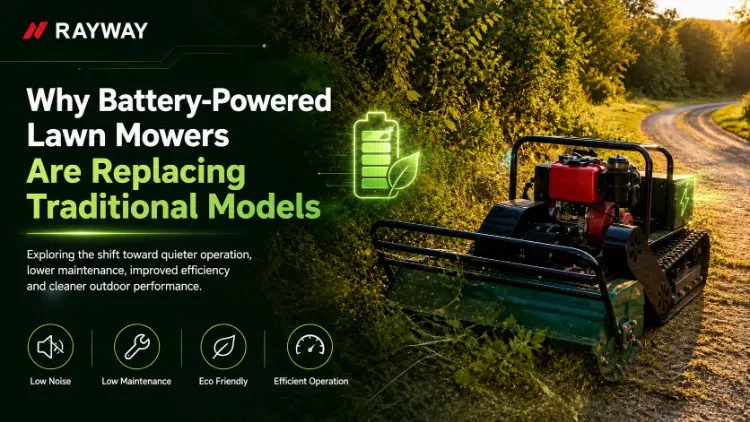
Why Battery-Powered Lawn Mowers Are Replacing Traditional Models
Industry Background and the Shift Toward Electrification
The global landscaping equipment industry is undergoing a significant transformation as sustainability requirements, urban noise regulations, and technological advancements continue to reshape product demand. Among these changes, battery-powered lawn mowers are rapidly gaining market share and are increasingly replacing traditional gas-powered models in residential, commercial, and light municipal applications.
This shift is largely driven by the global push toward cleaner energy solutions and reduced carbon emissions. Governments in North America and Europe are implementing stricter environmental policies that limit the use of small gasoline engines, particularly in urban areas. At the same time, end users are seeking quieter, lighter, and more convenient alternatives for lawn maintenance.
Industry research shows that the global battery-powered outdoor power equipment market is experiencing double-digit growth, with lawn mowers representing one of the fastest-expanding categories. Analysts project that electric and battery-powered lawn care products will continue to outpace traditional fuel-based equipment through 2030, driven by improvements in lithium-ion technology and declining battery costs.
Market Trends and Growth Drivers
One of the most important factors behind why battery-powered lawn mowers are replacing traditional models is the rapid improvement in battery energy density and motor efficiency. Modern lithium-ion batteries now offer longer runtime, faster charging cycles, and more stable power output compared to earlier generations, making them suitable for both residential and light commercial use.
Another key driver is regulatory pressure. Many countries have introduced restrictions on small engine emissions, especially in densely populated cities. For example, certain regions in the United States and Europe have already begun phasing out or limiting the use of gasoline-powered landscaping tools in municipal operations. This regulatory environment is accelerating the adoption of battery-powered alternatives.
Consumer behavior is also changing. Property owners and professional landscapers increasingly prioritize low-maintenance equipment that eliminates the need for fuel storage, engine oil changes, and complex mechanical servicing. As a result, demand for battery-powered lawn mowers is rising across both DIY homeowners and professional service providers.
Technology Advancements and Core Engineering Improvements
Modern battery-powered lawn mowers are no longer limited to small residential tasks. Advances in brushless motor technology, intelligent battery management systems, and lightweight composite materials have significantly improved performance and durability.
Brushless motors are now widely used due to their higher efficiency, reduced wear, and longer operational lifespan compared to traditional brushed motors. These motors deliver consistent torque output, allowing battery-powered lawn mowers to handle thicker grass and slightly uneven terrain without performance loss.
Battery systems have also evolved. High-capacity lithium-ion packs with smart thermal control systems help maintain stable output even under continuous load. Some advanced models feature dual-battery slots, enabling extended runtime for larger residential or semi-commercial applications.
From an engineering standpoint, manufacturers are focusing on weight optimization and structural reinforcement. Lightweight polymer decks combined with reinforced frame structures ensure portability without sacrificing durability. In addition, integrated battery placement improves balance and maneuverability, making the machines easier to control in tight garden spaces.
Manufacturing Process and Quality Control
The production of battery-powered lawn mowers involves a highly integrated manufacturing process combining electronics, mechanical engineering, and precision assembly. It typically begins with injection molding of the mower deck, followed by installation of the brushless motor system and electronic control unit.
Battery modules are assembled under strict safety standards, including cell balancing, insulation testing, and thermal resistance evaluation. After integration, each unit undergoes multi-stage testing that includes motor load simulation, runtime endurance testing, and vibration resistance checks.
Quality control is particularly important in export-oriented manufacturing. Each mower must meet international safety certifications and performance benchmarks to ensure compatibility with different market standards. Manufacturers also conduct field simulation tests to replicate real-world usage conditions such as dense grass cutting, slope operation, and extended runtime cycles.
Application Scenarios and Market Positioning
Battery-powered lawn mowers are widely used in residential gardens, urban landscaping, hotel grounds, rental property maintenance, and small commercial green spaces. Their quiet operation makes them especially suitable for noise-restricted environments such as hospitals, schools, and residential communities.
For B2B buyers, these machines offer a strong competitive advantage in service differentiation. Landscaping companies can operate early in the morning or in noise-sensitive zones without regulatory restrictions, improving operational flexibility and customer satisfaction.
In addition, the reduced maintenance requirements significantly lower long-term operational costs. Without fuel dependency, users benefit from simplified logistics and reduced downtime, making battery-powered solutions highly attractive for scalable landscaping businesses.
Industry Challenges and Future Outlook
Despite rapid growth, battery-powered lawn mowers still face certain limitations, particularly in runtime constraints for heavy-duty commercial applications. However, continuous improvements in battery energy density and fast-charging technology are expected to address these challenges in the near future.
Another ongoing development is the integration of smart features. Manufacturers are increasingly exploring IoT-enabled systems that allow users to monitor battery health, track usage data, and optimize cutting efficiency through mobile applications.
Looking ahead, the industry is expected to move toward a hybrid ecosystem where battery-powered equipment becomes the dominant solution for residential and light commercial use, while advanced high-capacity systems gradually expand into more demanding professional applications.
FAQ for International Buyers
Q1: Are battery-powered lawn mowers powerful enough to replace gas models?
Yes, modern battery-powered models equipped with brushless motors can handle most residential and light commercial tasks effectively.
Q2: How long does a typical battery-powered lawn mower run?
Runtime varies by model, but most units offer between 30 to 90 minutes of continuous operation depending on battery capacity and grass conditions.
Q3: What are the main maintenance requirements?
Maintenance is minimal, typically limited to blade sharpening, cleaning, and occasional battery inspection, with no fuel or oil required.
Q4: Are battery-powered lawn mowers suitable for professional landscaping companies?
Yes, they are increasingly used by professional landscapers, especially in urban areas with noise or emission restrictions.
Conclusion and Call to Action
As global landscaping practices continue to evolve, battery-powered lawn mowers are becoming a key replacement for traditional fuel-based models. Their combination of environmental benefits, operational efficiency, and low maintenance requirements positions them as the future standard in both residential and professional lawn care markets.
For distributors, wholesalers, and landscaping equipment importers, the transition toward electrification presents a significant opportunity. Partnering with a reliable manufacturer that offers stable quality, advanced battery technology, and OEM/ODM customization capabilities is essential to remain competitive.
If you are planning to expand your product line or enter the fast-growing electric landscaping equipment market, now is the ideal time to source high-performance battery-powered lawn mowers and strengthen your global market position.


