
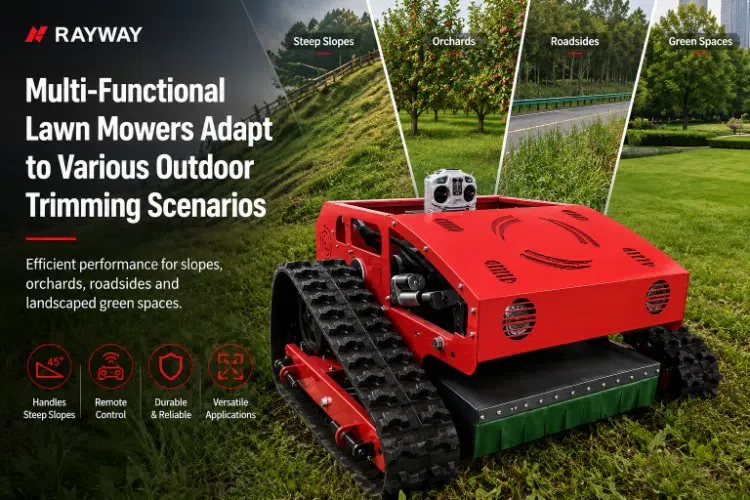
Multi-Functional Lawn Mowers Adapt to Various Outdoor Trimming Scenarios
Industry Background and Expanding Application Needs
The global landscaping and outdoor maintenance industry is experiencing a structural shift driven by diversification of application scenarios and rising expectations for equipment versatility. Within this context, multi-functional lawn mowers adapted to various outdoor trimming scenarios are becoming a key product category for both commercial landscaping operators and equipment distributors.
Unlike traditional single-purpose machines, modern lawn mowers are now expected to perform across multiple environments, including residential gardens, municipal green spaces, roadside landscapes, commercial properties, and semi-agricultural zones. This diversification of use cases is pushing manufacturers to redesign equipment systems that can support flexible attachments, adjustable cutting modes, and enhanced terrain adaptability.
Industry data indicates that the global lawn mower market continues to grow steadily, supported by increasing urban green coverage, infrastructure development, and demand for professional landscaping services. Analysts highlight that equipment flexibility is becoming a major purchasing factor, especially for B2B buyers who manage multiple project types and require cost-efficient, all-in-one solutions.
Market Trends and Demand for Versatile Equipment
One of the most important trends shaping the rise of multi-functional lawn mowers adapted to various outdoor trimming scenarios is the consolidation of equipment functionality. Instead of purchasing multiple specialized machines, contractors and maintenance companies increasingly prefer modular systems that can handle mowing, edging, mulching, and light brush cutting tasks within a single platform.
This shift is closely linked to cost optimization strategies in the landscaping industry. Companies are under pressure to reduce equipment investment costs while improving operational efficiency. As a result, demand for multi-functional systems has grown significantly in both developed and emerging markets.
Another key driver is the increasing complexity of outdoor environments. Urban landscapes are no longer limited to flat grass areas; instead, they often include slopes, narrow pathways, mixed vegetation zones, and irregular terrain. This requires machines that can adapt dynamically to different trimming scenarios without sacrificing performance or safety.
At the same time, sustainability considerations are influencing design direction. Manufacturers are integrating fuel-efficient engines and energy-optimized electric systems to reduce operational costs and environmental impact while maintaining high versatility.
Engineering Design and Functional Integration
The core advantage of multi-functional lawn mowers adapted to various outdoor trimming scenarios lies in their modular engineering structure. These machines are typically designed with interchangeable cutting systems, adjustable height controls, and compatibility with multiple attachments.
In many modern designs, the drive system is built around a universal power platform that supports both mowing decks and auxiliary tools such as brush cutters, leaf collectors, and edging units. This modular approach allows operators to switch functions quickly without requiring additional equipment.
From a technical perspective, cutting efficiency is achieved through optimized blade geometry and variable speed control systems. These features enable the machine to adjust performance based on grass density and terrain resistance, ensuring consistent results across different environments.
Ergonomic improvements are also a key focus. Adjustable handlebars, vibration reduction systems, and intuitive control interfaces improve operator comfort during long working hours. For commercial users, this translates into higher productivity and reduced fatigue.
Manufacturing Process and Quality Assurance
The production of multi-functional lawn mowers involves a highly integrated manufacturing process that combines mechanical fabrication with precision assembly. It typically begins with the formation of the main chassis using high-strength steel or reinforced polymer materials, followed by installation of the drive system and modular interface components.
Each unit is assembled with strict alignment standards to ensure compatibility between different functional attachments. Electrical and mechanical systems are tested separately before final integration to reduce operational risks.
Quality control procedures include torque testing, vibration analysis, load simulation, and real-world cutting performance evaluation. Export-grade machines must pass extended durability tests that simulate continuous operation in diverse outdoor environments such as dense vegetation, uneven terrain, and mixed soil conditions.
Surface treatment processes such as anti-rust coating and UV-resistant finishing are applied to enhance long-term durability, especially for machines used in humid or high-temperature regions.
Application Scenarios and Practical Value
Multi-functional lawn mowers adapted to various outdoor trimming scenarios are widely used across residential landscaping, municipal maintenance, commercial property management, roadside vegetation control, and recreational facility upkeep.
Their ability to switch between different operational modes allows a single machine to handle multiple tasks efficiently. For example, a contractor can use the same equipment for lawn mowing in residential areas, edging along sidewalks, and clearing light brush in public green spaces.
This flexibility significantly reduces equipment transportation costs and storage requirements. For companies managing large service networks, multi-functional systems provide a scalable solution that improves operational consistency across multiple job sites.
In addition, these machines are particularly valuable in regions with diverse terrain conditions, where traditional single-function equipment may struggle to deliver consistent performance.
Industry Challenges and Future Development
Despite strong demand, multi-functional lawn mowers adapted to various outdoor trimming scenarios face engineering challenges related to structural complexity and maintenance efficiency. As machines become more versatile, ensuring durability across all functional modes becomes increasingly important.
Manufacturers are addressing these challenges through improved material selection, simplified modular interfaces, and enhanced mechanical locking systems that improve stability during operation.
Looking ahead, the industry is expected to move toward smarter integration, including sensor-based adaptive cutting systems, digital control interfaces, and predictive maintenance capabilities. These innovations will further enhance the adaptability of multi-functional lawn mowers in complex outdoor environments.
FAQ for International Buyers
Q1: What makes multi-functional lawn mowers different from standard models?
They offer modular design and interchangeable attachments, allowing a single machine to perform multiple outdoor trimming tasks.
Q2: Are multi-functional lawn mowers suitable for commercial use?
Yes, they are widely used by landscaping companies due to their flexibility, efficiency, and reduced equipment investment costs.
Q3: Can these machines handle uneven or mixed terrain?
Yes, most models are designed with adjustable cutting systems and reinforced drive structures for varied terrain conditions.
Q4: Do multi-functional systems require more maintenance?
Not necessarily. While they have more components, modern designs focus on simplified maintenance and durable modular interfaces.
Conclusion and Professional Call to Action
As global landscaping demands continue to diversify, multi-functional lawn mowers adapted to various outdoor trimming scenarios are becoming essential tools for modern maintenance operations. Their ability to integrate multiple functions into a single platform offers clear advantages in cost efficiency, operational flexibility, and productivity.
For international distributors, wholesalers, and landscaping service providers, investing in multi-functional equipment represents a strategic opportunity to meet evolving market expectations. Partnering with a manufacturer that provides reliable engineering, stable quality control, and OEM/ODM customization capabilities is key to long-term success.
If you are looking to expand your product portfolio with high-performance, multi-functional lawn mower solutions, now is the right time to engage with a professional supplier and strengthen your competitiveness in the global outdoor equipment market.


