
Public green spaces need regular care. Parks, roadside verges, riverbanks, and public gardens all require reliable maintenance. However, each area brings different challenges. Some have flat lawns, while others feature steep slopes, thick vegetation, or narrow access routes.
At Shandong RAYWAY Lawnmower, we understand these challenges. We develop remote-controlled lawn mowers for demanding outdoor environments. Our machines help maintenance teams handle difficult terrain with greater control and efficiency. We also believe that choosing the right equipment matters more than simply buying the biggest machine.
A well-planned municipal landscaping equipment fleet can reduce labor pressure. It can also improve cutting quality and support safer operations. In this guide, we explore essential equipment, practical applications, and important purchasing factors. Let's find out what modern municipal landscaping teams really need.
1. What Is Municipal Landscaping Equipment?
Municipal landscaping equipment includes machines and tools used to maintain public outdoor spaces. Local governments, landscaping contractors, and public maintenance departments rely on these machines. Their main purpose involves controlling vegetation and keeping public areas clean, safe, and attractive.
Unlike ordinary garden tools, municipal equipment often handles demanding workloads. Operators may work across large areas every day. They also face different weather conditions and complicated terrain.
Common municipal landscaping equipment includes:
- Lawn mowers: Maintain parks, lawns, and roadside grass.
- Remote-controlled mowers: Cut vegetation on steep slopes and difficult terrain.
- Brush cutters: Remove weeds and dense vegetation.
- Mulching heads: Process grass, weeds, and small branches.
- Skid steers: Support multiple landscaping and material-handling tasks.
- Hedge trimmers: Maintain shrubs, hedges, and decorative plants.
- Leaf blowers: Clear leaves and loose debris.
- Compact tractors: Handle larger grounds and agricultural-style maintenance.
- Chainsaws: Remove unwanted branches and support tree maintenance.
Each machine serves a different purpose. Therefore, maintenance teams should match equipment to their actual working conditions.
2. Essential Equipment for Green Area Maintenance
Effective green area maintenance requires more than regular mowing. Municipal teams must manage grass, shrubs, weeds, leaves, and unwanted vegetation. Different locations also require different equipment combinations. A city park needs different machines from a roadside embankment.
2.1 Commercial and Professional Lawn Mowers
Commercial lawn mowers form the foundation of municipal grass maintenance. They work well in parks, sports grounds, public gardens, and roadside green belts. These machines offer consistent cutting performance across large grassy areas.
When choosing a commercial mower, consider these specifications:
| Parameter | What to consider |
|---|---|
| Cutting width | 80–150 cm or more, depending on the application |
| Cutting height | Adjustable to suit different grass conditions |
| Engine power | Suitable for grass density and working area |
| Drive system | Two-wheel or four-wheel drive |
| Cutting system | Rotary, flail, or other suitable designs |
| Maintenance | Easy access to blades and service components |
A wider cutting deck can improve productivity in open spaces. However, narrow machines work better around trees and benches. We recommend considering both working efficiency and maneuverability.
2.2 Remote-Controlled Lawn Mowers
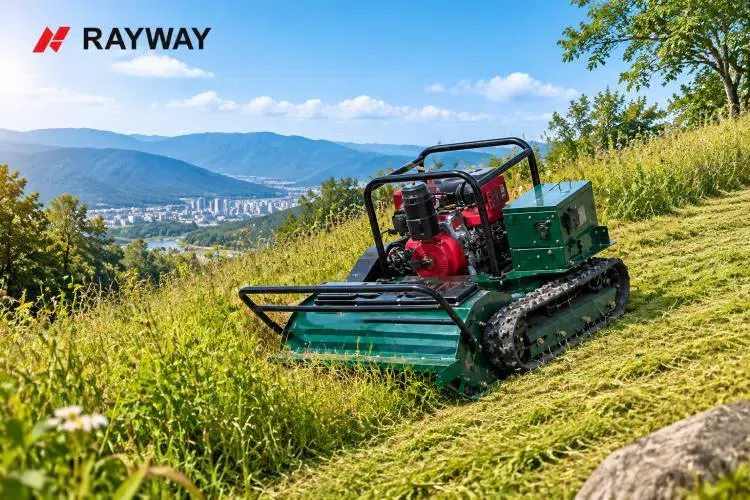
Remote-controlled lawn mowers offer another solution for demanding municipal projects. They allow operators to control mowing operations from a safer working position. This advantage becomes especially valuable on steep slopes and uneven ground.
Traditional riding mowers may struggle with certain embankments. Their operating limits depend on machine design and terrain conditions. A remote-controlled mower can reduce the need for operators to ride directly on challenging slopes.
At Shandong RAYWAY Lawnmower, we focus on machines for difficult mowing environments. Our tracked models combine rubber tracks, strong traction, and remote operation. These features help operators manage vegetation across demanding landscapes.
Typical applications include:
- Roadside embankments and drainage channels.
- Riverbanks and reservoir surroundings.
- Public parks with uneven terrain.
- Hillsides and roadside green belts.
- Large areas with dense grass and weeds.
- Photovoltaic power station vegetation control.
However, remote operation does not remove every risk. Operators must follow the manufacturer's slope limits and maintain clear visibility. They should also inspect the terrain before starting work.
2.3 Brush Cutters and Flail Mowers
Brush cutters handle areas where ordinary lawn mowers cannot work efficiently. They can remove tall grass, weeds, and unwanted vegetation. Handheld models suit small spaces, while larger attachments support commercial maintenance.
Flail mowers provide another useful option. Their rotating flails cut and break vegetation into smaller pieces. This makes them suitable for roadside verges, rough grass, and areas with mixed vegetation.
Municipal teams should compare:
- Cutting width and working capacity.
- Suitable vegetation thickness.
- Blade or flail replacement costs.
- Required engine or hydraulic power.
- Maintenance requirements.
- Debris discharge and safety protection.
The right cutting system depends on vegetation density. A neat public lawn rarely needs the same equipment as an overgrown roadside.
2.4 Mulching Heads
Mulching heads help process dense vegetation and smaller woody growth. They often connect to skid steers, excavators, or other compatible carriers. Their rotating cutting components break vegetation into smaller pieces.
These attachments can support several municipal tasks:
- Clearing roadside vegetation.
- Managing overgrown green belts.
- Processing brush and small branches.
- Maintaining selected drainage areas.
- Controlling vegetation around infrastructure.
However, operators must check compatibility before purchasing. Hydraulic flow, pressure, carrier weight, and attachment size all matter. An unsuitable combination can reduce performance and increase mechanical stress.
Mulching heads also create serious flying-debris hazards. Maintenance teams should establish exclusion zones and follow attachment instructions. For example, Victoria's government operating guidance specifies a 100-meter exclusion zone for its particular skid steer mulching operation. This is an equipment-specific instruction, not a universal distance.
2.5 Skid Steers and Multi-Purpose Loaders
Skid steers are popular in municipal landscaping because they support multiple attachments. One carrier can perform several different tasks throughout the year. This flexibility can improve equipment utilization.
Common skid steer attachments include:
- Brush cutters.
- Mulching heads.
- Buckets and forks.
- Rotary brooms.
- Landscape rakes.
- Snow removal attachments.
- Soil preparation tools.
For example, a city maintenance department may use one skid steer for vegetation clearing during summer. The same machine can support snow removal during winter.
Nevertheless, skid steers are not ideal for every location. Their weight and ground pressure can damage soft soil or sensitive vegetation. Their stability also depends on attachment weight and working conditions.
We recommend checking hydraulic compatibility, rated operating capacity, and ground conditions. A versatile machine only creates value when the operator uses it correctly.
3. Choosing Equipment for Different Municipal Areas
A municipal landscaping fleet should reflect the actual environment. Buying equipment without considering its working location often wastes money. Therefore, we suggest dividing public spaces into practical maintenance zones.
3.1 Parks and Public Gardens
Parks require regular grass cutting and detailed landscape care. Visitors expect clean lawns, attractive flower beds, and tidy walking paths. Maintenance teams must also avoid damaging trees, benches, and irrigation systems.
Suitable equipment includes:
- Commercial lawn mowers for open lawns.
- Small brush cutters for edges and corners.
- Hedge trimmers for shrubs.
- Leaf blowers for seasonal cleanup.
- Compact utility machines for material transport.
Quiet operation can also improve the visitor experience. Whenever possible, schedule noisy maintenance outside busy visiting hours.
3.2 Roadsides and Highway Green Belts
Roadside vegetation affects visibility and public safety. Overgrown grass can hide signs, obstruct sightlines, and cover drainage structures. Regular maintenance helps keep these areas functional.
Different roadside sections need different machines. Flat verges may suit tractor-mounted mowing equipment. Narrow areas may require compact mowers or brush cutters. Difficult embankments may need specialized remote-controlled equipment.
Maintenance teams should also consider wildlife and erosion. Frequent mowing does not always produce better roadside management. The Federal Highway Administration discusses vegetation management and the importance of minimizing ground disturbance.
3.3 Riverbanks and Drainage Channels
Riverbanks often present challenging working conditions. Slopes, wet soil, stones, and uneven surfaces can complicate mowing. Conventional equipment may struggle to maintain stable traction.
Remote-controlled tracked mowers can provide a practical alternative. Operators can control the machine without riding directly on the working slope. However, they must assess soil stability, water levels, and machine limitations first.
Maintenance teams should avoid unnecessary operations on saturated ground. Wet soil can increase slipping, rutting, and erosion risks. Sometimes, waiting for better ground conditions is the smartest maintenance decision.
3.4 Steep Slopes and Difficult Terrain
A steep slope requires careful equipment selection. Ordinary riding mowers can become unstable when they exceed their operating limits. This creates serious rollover risks for operators.
OSHA advises employers to follow manufacturer slope limits. It also recommends avoiding slopes above 15 degrees when suitable manufacturer guidance is unavailable. This figure should not replace the actual machine specifications.
For challenging terrain, consider these equipment features:
- Rubber tracks: Improve traction and distribute machine weight.
- Low center of gravity: Helps support machine stability.
- Remote control: Keeps operators away from the cutting platform.
- Suitable cutting deck: Handles grass and vegetation efficiently.
- Emergency stop: Allows operators to stop the machine quickly.
- Protective design: Helps protect key components during demanding work.
At Shandong RAYWAY, we believe equipment selection should start with terrain conditions. A machine that works perfectly on flat grass may perform poorly on a hillside. Matching machine design to the working environment makes a real difference.
4. How to Choose the Right Municipal Landscaping Machinery
Selecting municipal landscaping equipment involves more than comparing prices. A machine may look powerful but still fail to meet actual project requirements. We recommend evaluating several important factors before making a purchasing decision.
4.1 Evaluate the Working Environment
Start by inspecting the maintenance area. Measure its size and identify the main terrain conditions. Also, check grass height, vegetation density, soil type, and access restrictions.
Consider the following questions:
- Is the ground flat, uneven, or sloped?
- Does the area contain stones, roots, or tree stumps?
- Does the machine need to pass through narrow spaces?
- Will operators encounter wet grass or soft soil?
- Does the project involve ordinary grass or woody vegetation?
- Are there pedestrians, roads, or nearby buildings?
These details help narrow down suitable machine types. They also prevent unnecessary spending on unsuitable equipment.
4.2 Compare Productivity and Cutting Capacity
Municipal maintenance departments often manage large areas under tight schedules. Therefore, working efficiency deserves serious attention. Cutting width, travel speed, engine power, and vegetation density all influence productivity.
A wider cutting deck may cover more ground per pass. However, it cannot guarantee higher productivity in every situation. Narrow paths, trees, and obstacles may reduce its advantages.
We suggest comparing these parameters:
| Performance factor | Why it matters |
|---|---|
| Cutting width | Determines the area covered per pass |
| Working speed | Influences daily operating capacity |
| Engine power | Supports demanding cutting conditions |
| Fuel consumption | Affects operating expenses |
| Cutting height | Helps adapt to different vegetation |
| Turning ability | Improves maneuverability |
| Maintenance intervals | Influences equipment availability |
Always evaluate productivity under realistic working conditions. Manufacturer specifications provide useful information, but actual results may differ.
4.3 Consider Safety Features
Safety should guide every equipment purchase. Municipal workers often operate near roads, pedestrians, buildings, and waterways. A small mistake can create significant consequences.
Look for suitable safety features, including:
- Emergency stop systems.
- Rollover protection where applicable.
- Blade protection and discharge guards.
- Reliable braking systems.
- Clear operator controls.
- Protective covers for moving components.
- Suitable visibility and warning systems.
Remote-controlled machines also require clear operating procedures. Operators should maintain a safe distance and watch the entire working area. They must never assume remote operation makes a dangerous slope completely safe.
OSHA identifies equipment inspection, worker training, and protection from moving cutting components as important landscaping safety measures.
4.4 Calculate Total Ownership Costs
The purchase price represents only one part of equipment costs. Municipal departments should also consider long-term operating expenses.
Important costs include:
- Initial equipment investment.
- Fuel or electricity consumption.
- Routine maintenance.
- Replacement blades and cutting components.
- Hydraulic oil and filters.
- Transportation and storage.
- Operator training.
- Unexpected repairs and downtime.
A cheaper machine may require more frequent repairs. Meanwhile, a more expensive machine may provide better long-term value. The best choice depends on workload, service support, and expected operating life.
4.5 Check Attachment Compatibility
Attachments can increase equipment flexibility. However, not every attachment fits every carrier. This is particularly important when purchasing skid steers and mulching heads.
Before purchasing, confirm:
- Hydraulic flow requirements, measured in L/min or GPM.
- Hydraulic pressure requirements, measured in bar or PSI.
- Carrier operating weight and rated capacity.
- Attachment working width.
- Mounting system compatibility.
- Required protective equipment and safety features.
Always follow the carrier and attachment manufacturers' specifications. Incorrect combinations can cause overheating, unstable operation, or equipment damage.
5. Why Remote-Controlled Mowers Matter in Modern Cities
Urban maintenance requirements continue to change. Cities must maintain more public spaces while controlling labor and operating costs. Meanwhile, maintenance workers increasingly face difficult terrain and restricted access.
Remote-controlled lawn mowers offer several practical advantages in these situations.
5.1 Improved Operator Positioning
Traditional mowing sometimes requires operators to work directly on difficult slopes. This can expose them to rollover and slipping hazards. Remote-controlled machines allow operators to control mowing from outside the machine.
This approach can reduce direct exposure to certain terrain hazards. However, operators still need appropriate training and safe working procedures.
5.2 Better Access to Difficult Areas
Tracked remote-controlled mowers can access locations that challenge conventional equipment. Rubber tracks provide traction across suitable uneven surfaces. Their compact designs can also help them work in selected restricted areas.
Common applications include:
- Steep roadside embankments.
- Riverbanks and drainage areas.
- Hillside parks.
- Municipal green belts.
- Overgrown public spaces.
- Solar farm vegetation control.
Actual performance depends on slope angle, ground conditions, machine specifications, and operating methods.
5.3 Flexible Vegetation Management
Different seasons bring different vegetation challenges. Spring encourages rapid grass growth, while summer often produces thicker weeds. Autumn brings fallen leaves and additional cleanup work.
Remote-controlled mowers can support routine grass and vegetation management. Some models also use specialized cutting systems for tougher vegetation. This flexibility helps municipal teams plan maintenance across different environments.
At Shandong RAYWAY Lawnmower, we focus on practical solutions for demanding mowing conditions. We combine tracked mobility with remote operation to support professional users. Our goal is simple: help maintenance teams complete difficult mowing tasks more efficiently.
6. Practical Tips for Efficient Green Area Maintenance
Even excellent equipment cannot replace proper maintenance planning. Municipal teams need a clear schedule and consistent operating procedures. We recommend the following practices.
6.1 Create a Seasonal Maintenance Plan
Different areas require different mowing frequencies. A public park may need frequent cutting during spring and summer. A roadside area may require fewer mowing operations.
A practical maintenance schedule should include:
| Season | Main maintenance tasks |
|---|---|
| Spring | Remove winter debris and control rapid grass growth |
| Summer | Maintain lawns and manage tall vegetation |
| Autumn | Control weeds and clear fallen leaves |
| Winter | Inspect equipment and prepare maintenance plans |
Adjust this schedule according to local weather and vegetation growth. Avoid unnecessary mowing when it could damage soil or desirable plants.
6.2 Inspect Equipment Before Every Operation
A short inspection can prevent expensive problems. Operators should check essential components before starting work.
We recommend checking:
- Blade condition and attachment security.
- Track tension and rubber track condition.
- Engine oil and hydraulic fluid.
- Fuel levels and cooling systems.
- Remote control and emergency stop functions.
- Protective covers and safety devices.
- Loose bolts, damaged hoses, and unusual leaks.
Record inspection results when possible. Consistent records help maintenance managers identify recurring problems.
6.3 Train Operators Properly
Modern machinery still requires skilled operators. Training should cover controls, machine limitations, maintenance, and emergency procedures.
Operators should also understand the surrounding environment. They must recognize pedestrians, hidden obstacles, unstable soil, and overhead hazards. Good training protects both workers and public spaces.
6.4 Protect Soil and Existing Vegetation
Heavy machinery can damage sensitive ground. Excessive traffic may compact soil and harm plant roots. Therefore, use equipment that suits the site's ground conditions.
Avoid unnecessary operations on wet or unstable surfaces. Maintain suitable vegetation buffers near trees and waterways. Also, remove debris before mowing whenever practical.
The US Environmental Protection Agency recommends careful equipment selection for green infrastructure maintenance. It warns that unnecessary heavy equipment can compact soil and damage roots.
7. Future Trends in Municipal Landscaping Equipment
Municipal landscaping is gradually moving toward smarter equipment and more efficient maintenance methods. Remote control, automation, and improved machine designs are changing traditional operations.
7.1 Intelligent and Remote-Controlled Machinery
Remote control technology gives operators greater flexibility. They can manage machines without sitting directly on the equipment. Some modern models also include digital displays and improved control systems.
In the future, intelligent features may further improve maintenance efficiency. Better monitoring can help teams track machine conditions and plan servicing. However, reliable mechanical performance remains essential.
7.2 More Versatile Equipment Combinations
Municipal departments increasingly value machines that support different applications. Multi-purpose carriers and interchangeable attachments can reduce equipment duplication.
For example, skid steers can support mulching heads, buckets, and brush cutters. Remote-controlled mowers can handle challenging grass-cutting tasks. Choosing complementary machines creates a more flexible fleet.
7.3 Greater Attention to Environmental Protection
Modern green area maintenance should balance appearance and environmental protection. Excessive mowing can disturb wildlife habitats and damage vegetation. Unnecessary heavy equipment can also increase soil compaction.
Municipal teams should consider:
- Appropriate mowing frequency.
- Reduced ground disturbance.
- Responsible vegetation disposal.
- Lower-emission equipment where practical.
- Protection of drainage systems and plant roots.
- Better planning around local ecological conditions.
We believe efficient landscaping should protect both public spaces and their natural surroundings.
8. Conclusion: Build a Smarter Municipal Maintenance Fleet
Choosing the right municipal landscaping equipment requires careful planning. Different locations demand different machines, attachments, and operating methods. Commercial mowers, brush cutters, mulching heads, and skid steers all have important roles.
However, difficult terrain deserves special attention. Steep slopes, riverbanks, and uneven ground can challenge conventional mowing equipment. Remote-controlled tracked mowers offer another practical solution for these environments.
At Shandong RAYWAY Lawnmower, we understand the demands of professional vegetation management. We focus on developing remote-controlled lawn mowers for challenging working conditions. Our goal is to help municipal contractors and landscaping teams improve productivity and operator positioning.
A smarter equipment fleet does not simply contain more machines. It contains the right machines for the right jobs. With proper planning, suitable equipment, and trained operators, cities can maintain cleaner and greener public spaces.
Looking for reliable equipment for challenging municipal mowing projects? Explore Shandong RAYWAY's remote-controlled lawn mower solutions and discover a better approach to difficult terrain maintenance.


