
Choosing the right vegetation clearing equipment can make a big difference. Some areas need simple trimming, while others demand serious cutting power. A brush cutter works well for smaller spaces and detailed tasks. However, large fields and steep hills create different challenges.
At Shandong RAYWAY Lawnmower, we understand these challenges. We develop remote-controlled lawn mowers for demanding outdoor environments. Our machines help operators manage tall grass, thick weeds, and difficult terrain. So, which machine should you choose? Let's compare their performance, costs, and practical uses.
1. What Is a Brush Cutter?
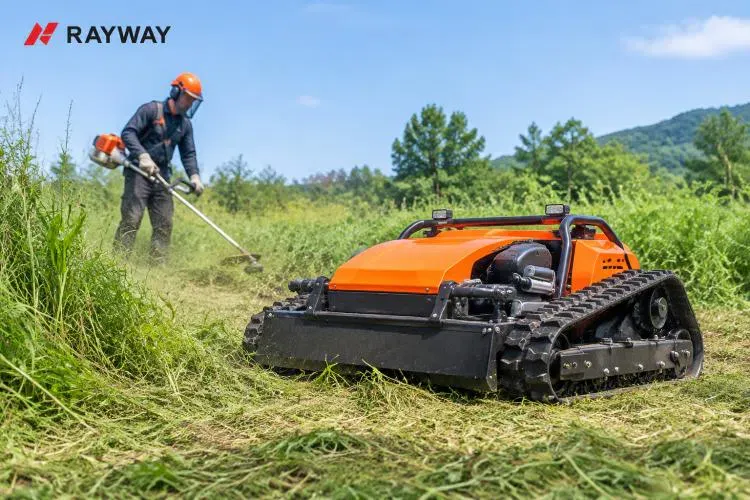
A brush cutter is a handheld power tool for cutting grass, weeds, and light brush. Most models use a rotating metal blade or nylon cutting line. Operators control the machine through handles and a shoulder harness. Its compact design makes it useful around trees, fences, and narrow spaces.
Main Advantages of Brush Cutters
Brush cutters offer several practical benefits for everyday vegetation maintenance:
- Flexible operation: Operators can reach corners and narrow spaces.
- Easy transportation: Most models fit inside ordinary work vehicles.
- Lower initial cost: Basic models usually require a smaller investment.
- Precise cutting: Users can trim around trees, posts, and garden edges.
- Simple maintenance: Many models have straightforward mechanical structures.
However, these machines require physical effort. Long working hours can cause fatigue, especially when operators handle thick vegetation. They also need suitable protective equipment and careful operation. A small tool can still create serious hazards.
2. What Is a Remote-Controlled Mower?
A remote-controlled mower uses an engine or motor to power its cutting system. Instead of walking behind the machine, operators control it remotely. Many commercial models use rubber tracks for better traction. This design helps them handle uneven ground and challenging outdoor conditions.
At Shandong RAYWAY Lawnmower, we focus on practical mowing solutions. Our remote-controlled machines serve farms, orchards, hillsides, and roadside vegetation areas. They help operators maintain grass without riding directly on the machine. This approach can reduce physical effort and improve working convenience.
Key Features of Remote-Controlled Mowers
Modern remote-controlled mowers offer several useful features:
- Remote operation: Operators control movement and cutting functions from a distance.
- Tracked mobility: Rubber tracks provide traction across many uneven surfaces.
- Powerful cutting systems: Different cutting systems handle different vegetation conditions.
- Adjustable cutting height: Operators can select suitable cutting heights for each task.
- Wide working coverage: Larger cutting widths help cover open areas efficiently.
Of course, not every model offers identical performance. Buyers should check climbing ability, cutting width, engine power, and operating limits. These details matter more than impressive product photographs.
3. Brush Cutter vs Remote Mower: Key Differences
The main difference involves operating methods and working capacity. A brush cutter depends on direct human control and physical movement. A remote mower uses powered movement and remote operation. Therefore, each machine suits different maintenance requirements.
Performance and Working Efficiency
A brush cutter works well for scattered weeds and small areas. However, operators must move continuously across the working site. This process becomes tiring when vegetation covers several hectares.
Remote mowers offer another approach. Their wider cutting systems can cover larger areas with fewer walking movements. A suitable tracked model can also handle dense grass and uneven ground. For commercial vegetation maintenance, this difference can become important.
Research published in the Journal of Agricultural Machinery and Food Engineers examined remote-controlled mowing technology. One prototype achieved higher working efficiency than several comparison machines. Its reported efficiency reached 2.6 times that of a walking-type mower. Results also showed advantages over a brush cutter in specific field conditions.
Terrain Adaptability
Terrain can completely change equipment performance. Brush cutters provide excellent flexibility around obstacles and narrow passages. Nevertheless, steep slopes require careful footing and physical balance.
Tracked remote mowers offer stronger support for many challenging conditions. Their tracks distribute machine weight across a larger contact area. This design can improve traction and reduce ground pressure. However, operators must always follow the manufacturer's slope limits.
Safety and Operator Comfort
Brush cutter operators work close to rotating blades and flying debris. They need appropriate clothing, eye protection, hearing protection, and safe working distances. The NSW Rural Fire Service also provides detailed brush cutter operating guidance.
Remote-controlled mowers allow operators to stand away from the cutting machine. This reduces direct exposure to vibration, noise, and cutting hazards. However, remote operation does not eliminate every risk. Operators must maintain visibility and keep people away from the working area.
4. Which Machine Works Better in Different Environments?
The best equipment depends on the site, vegetation, and maintenance schedule. Buying the biggest machine does not always produce the best results. Sometimes, a compact tool saves more time and money.
Small Gardens and Narrow Areas
A brush cutter usually works better for small gardens. It can reach corners, tree bases, and narrow spaces. Operators can also control the cutting direction precisely.
A remote mower may struggle around closely spaced obstacles. Its larger body needs enough room to move safely. Therefore, handheld equipment remains useful for detailed trimming.
Large Fields and Dense Vegetation
Large fields often require powerful vegetation clearing equipment. Brush cutters can handle thick grass, but operators must cover every section manually. This increases working time and physical demands.
A remote-controlled mower can provide better productivity across suitable open areas. Its wider cutting deck reduces the number of required passes. Heavy-duty cutting systems can also handle demanding grass conditions. This makes them attractive for farms, orchards, and commercial maintenance.
Steep Slopes and Uneven Ground
Steep slopes present serious challenges for traditional mowing equipment. Slippery grass, loose soil, and hidden obstacles increase operating risks. A brush cutter requires stable footing and careful body positioning.
Tracked remote mowers provide another solution. Operators can control the machine from a safer position. However, they must check the actual slope angle and ground conditions. Never assume every remote mower can handle every hillside.
OSHA recommends checking equipment limits before mowing slopes. It also highlights rollover hazards around wet surfaces and uneven ground.
5. How Much Does Each Machine Cost to Operate?
Purchase price represents only part of the total cost. Buyers should also consider labor, fuel, maintenance, and working hours. A cheaper machine may become expensive when it requires more operators.
Brush cutters usually have lower initial purchase costs. Their maintenance often involves blades, filters, fuel systems, and basic engine components. However, large projects may require several workers.
Remote-controlled mowers usually require a larger initial investment. They also need regular track, blade, engine, and hydraulic system inspections. Nevertheless, they can reduce manual labor across large maintenance areas.
Before purchasing, compare these important factors:
- Initial equipment price and financing costs.
- Fuel consumption and daily operating hours.
- Cutting width and expected working capacity.
- Labor requirements for each maintenance project.
- Replacement parts and routine service costs.
- Transportation and storage requirements.
The right choice depends on long-term operating needs, not price alone.
6. How to Choose the Right Vegetation Clearing Equipment
Before choosing a machine, we recommend evaluating your actual working conditions. Start with the area size and vegetation type. Then consider slopes, obstacles, soil conditions, and available labor.
Use this simple guide:
| Working Condition | Recommended Equipment |
|---|---|
| Small gardens | Brush cutter |
| Tree bases and narrow corners | Brush cutter |
| Large grass fields | Remote-controlled mower |
| Dense vegetation | Heavy-duty remote mower |
| Steep hillsides | Suitable tracked remote mower |
| Mixed terrain | Combination of both machines |
For commercial users, a combination often delivers the best results. A remote mower handles large areas, while a brush cutter finishes difficult corners. This approach avoids forcing one machine into every situation.
At Shandong RAYWAY Lawnmower, we believe equipment should match the job. Our remote-controlled lawn mowers help customers manage demanding mowing environments. We focus on practical performance, stable operation, and efficient vegetation maintenance.
Conclusion
The choice between a brush cutter and a remote mower depends on your working environment. Brush cutters offer flexibility, portability, and precise trimming. Remote-controlled mowers provide better support for large areas and many challenging terrains.
If you maintain small gardens, a brush cutter may be enough. However, large fields, steep slopes, and commercial projects often need more capable machinery. The right vegetation clearing equipment can save labor and improve productivity. Most importantly, it helps your team complete demanding work with greater confidence.
At Shandong RAYWAY Lawnmower, we continue developing reliable remote-controlled mowing solutions. We hope this comparison helps you make a smarter equipment investment.


